Industrial Tires · Plant & Warehouse Guide

How to Spec Industrial Tires for Total Cost of Ownership

On a plant floor, forklifts, reach trucks, and order pickers run continuous shifts on tight tolerances — and a single blown tire can idle equipment, delay shipments, and stall a production line.

S&S Tire Commercial Division 8 min read Manufacturing · Warehouse · Material Handling

A tire failure on a construction haul road is disruptive. A tire failure on a manufacturing plant floor can shut down an entire production line.

Forklifts, reach trucks, and order pickers run continuous shifts on tight tolerances. A single blown tire idles equipment, delays shipments, and triggers a cascade of downstream costs that dwarf the price of the tire itself. As labor and material costs rise, operations are demanding longer tire life, lower lifecycle cost, and vendors who can support the equipment in the field — not just sell the product.

Controlling that spend comes down to three decisions: selecting the right tire type for the application, maintaining it to manufacturer spec, and choosing a vendor on total cost of ownership rather than unit price. Get those right and your tire program controls costs instead of reacting to them.

#1

The cost that matters

Downtime — equipment out of service — is consistently the largest hidden cost in a plant tire program. The purchase price is rarely the number that matters most.

This guide walks through each of those three levers in practical terms, with the application matching, inspection habits, and vendor criteria that separate operations that control their tire spend from those that react to it.

1 Tire Selection

Match the Tire Type to the Application

The single most common cause of premature industrial tire failure is a mismatch between tire type and operating environment. Most buying decisions skip that step entirely and default to whatever was on the equipment last time. There are three primary tire types used in manufacturing and material handling — and they are not interchangeable.

01

Solid Resilient

No air means no flats and no pressure management — the default for high-intensity indoor work where puncture risk is high, like plants with metal scrap, debris, or rough concrete floors. The tradeoff is ride quality and heat. Replace at two-thirds of original rubber height, after which performance and safety degrade.

02

Pneumatic

Air-filled tires deliver superior cushioning and traction for outdoor yards, loading docks, and mixed surfaces, handling uneven terrain and heavier loads. The catch is pressure discipline: underinflated pneumatics flex excessively, build heat, and stress the sidewall — the same failure modes seen in over-the-road tires.

03

Cushion

Built for smooth indoor surfaces. They sit lower than pneumatics, lowering the equipment’s center of gravity for stability in narrow-aisle racking, and the low profile tightens the turning radius on dense storage layouts. Not suitable for outdoor use or rough surfaces.

Application matching at a glance

Construction, compound, and tread pattern all vary by environment. A tire that works for indoor racking is the wrong spec for an outdoor lumberyard, and vice versa. Here is how the three categories line up:

Tire Type Best Environment Key Advantage Key Limitation
Solid resilient Indoor, debris-heavy floors No flats, no pressure management Heat in long cycles, harder ride
Pneumatic Outdoor yards, mixed surfaces Cushioning, load capacity Requires pressure maintenance
Cushion Smooth indoor floors, narrow aisles Stability, low profile Not suitable for outdoor use

Before you specify, answer three questions

  • What surface does this equipment operate on — smooth concrete, rough yard, or both?
  • Does it transition between indoor and outdoor environments during a shift?
  • What is the duty cycle — continuous multi-shift use, or intermittent?

If operational changes are coming — a new facility, an added third shift — factor those into the spec now. A tire sized for today’s duty cycle may be undersized for next year’s throughput.

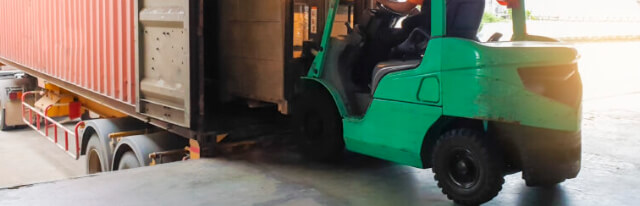
Forklift loading a freight container at a warehouse dock
S&S stocks cushion, pneumatic, solid and non-marking industrial tires from 10+ major brands across 14 commercial centers

2 Maintenance

Maintain to Spec, Not to Convenience

Correct selection gets you the right product. Maintenance determines how long it performs before it needs replacing. In plants running multiple shifts with short maintenance windows, tire care gets deprioritized until something fails — and that’s the pattern that drives up lifecycle cost.

The Inspection Baseline

Every program needs a documented inspection routine tied to equipment use, not calendar time. For high-utilization forklifts running two or three shifts, a pre-shift visual check is the minimum standard:

  • Wear depth — replace solid resilient tires at two-thirds of original rubber height; pneumatics once tread wear is evident
  • Chunking & tearing — common in debris-heavy environments; a sign the compound is wrong for the floor
  • Heat cracking — sidewall cracking from thermal stress means the tire is running beyond its duty-cycle capacity
  • Bead & rim condition — damage here causes mounting failures and uneven wear
  • Pressure (pneumatic only) — checked cold, against the manufacturer’s spec for the current load

Skipping inspections doesn’t save time. It converts a scheduled replacement into an emergency one — usually at the worst possible moment in the production schedule.

Industrial lift equipment staged in a service yard

From Calendar-Based to Condition-Based

The most significant shift in industrial tire management is the move to condition-based scheduling. IoT sensors built into tire casings monitor pressure, temperature, load, speed, and estimated tread life in real time, feeding telematics platforms that flag anomalies before they become failures.

An inspection routine tied to how equipment is actually used — not the calendar — is what keeps a scheduled replacement from becoming an emergency one.

— S&S Tire field service guidance

For operations running large equipment fleets across multiple shifts, service is triggered by actual tire data rather than the clock. The result is fewer emergency replacements, better parts planning, and documented performance data that supports vendor accountability — the difference between a tire program you manage and one that manages you.

3 Total Cost of Ownership

Buy on Total Cost of Ownership, Not Unit Price

This is where most industrial tire procurement goes wrong. The tire with the lowest unit price almost never delivers the lowest total cost — an inexpensive tire with shorter life or higher downtime costs more over time.

The Four Costs That Make Up TCO

  • Acquisition — the invoice price, including delivery and mounting
  • Maintenance — labor and materials for inspection, pressure management, and repairs
  • Downtime — equipment out of service, idle operators, and delayed production; consistently the largest and most underestimated variable
  • Disposal — removal, recycling, or disposal at end of life

A forklift running three shifts generates real revenue per hour. A failure that takes the machine offline for four hours — waiting on a vendor to respond — can cost multiples of the tire’s purchase price in lost throughput alone.

What Vendor Resilience Actually Means

Supply-chain disruptions and freight delays have compressed the number of vendors who can reliably meet OEM specs on short lead times. Four criteria separate a resilient vendor from a generalist tire seller:

  • Local or regional inventory — the right tire from stock, not a multi-week lead time on every order
  • On-site service capability — mounting and pressing tires at your facility instead of pulling equipment off the floor
  • Response-time commitment — a documented standard for emergency replacements during production hours
  • Application expertise — a team that knows forklift specs, load ratings, and duty-cycle matching

S&S Tire checks all four: 14 commercial centers across Kentucky, Tennessee, Alabama and West Virginia, TIA-certified technicians, mobile tire-press trucks that install at your warehouse or jobsite, and 50+ years matching tires to the application. A cheaper tire from a vendor who can’t reach your plant for 48 hours isn’t actually cheaper.

The Bottom Line

Industrial tire strategy isn’t a purchasing decision. It’s an operational one.

The right tire type, maintained correctly, from a vendor with genuine application expertise and on-site capability, is what keeps equipment running and production schedules intact. The wrong tire — or the right tire from the wrong vendor — is what creates the emergency calls and unplanned downtime that inflate lifecycle cost far beyond what any unit-price savings could offset.

Three questions every plant buyer should answer

Is the current tire type matched to the actual operating environment — surface, duty cycle, and any indoor-to-outdoor transitions?

Is there a documented inspection routine in place, tied to equipment usage rather than a calendar?

Does the current vendor have the local inventory, on-site capability, and application knowledge to support the fleet when it counts?

If any of those answers is uncertain — that’s where the next failure is coming from.

Schedule an On-Site Industrial Tire Assessment

S&S Tire supports manufacturing and material-handling operations with application-specific tire selection, on-site press service, and the regional inventory depth to respond when equipment can't wait. Let's talk through your plant's tire program.

Talk to a Specialist