
Commercial truck alignment problems rarely announce themselves with a warning light or fault code. More often, the first measurable evidence appears in the tires. A driver may initially mention that a truck pulls slightly or requires more steering correction, but as the change becomes familiar, the driver compensates and the complaint disappears. Months later, the steer tires come off earlier than expected, and tire quality gets blamed for the lost mileage.
In many cases, the tire is documenting a problem somewhere else in the vehicle. Learning to read irregular tire wear can help fleets identify alignment, suspension, balance, and axle problems before another set of tires pays the price.
Key Takeaways
- Misalignment can develop gradually, allowing drivers to adapt to pulling, wandering, or an off-center steering wheel.
- Feathering commonly points toward toe problems, while one-shoulder wear can indicate camber or axle alignment issues.
- Cupping may indicate worn suspension components or wheel imbalance rather than an alignment-angle problem.
- Trailer alignment also matters. A misaligned trailer can increase tire wear and drag even when the tractor is properly aligned.
- Tire wear patterns should be documented by unit, so recurring problems can be identified before premature tire replacement becomes routine.
- A complete heavy-duty alignment evaluates more than the steer axle. Drive axle thrust, trailer axle alignment, suspension condition, inflation, and balance can all affect tire life.
Why Commercial Truck Misalignment Is Easy to Miss
Alignment typically drifts rather than fails all at once. Potholes, curb strikes, heavy loads, impacts, worn components, and normal settling can gradually change vehicle geometry.
Drivers often compensate without realizing it. A little extra pressure on the steering wheel eventually becomes normal. That makes driver feedback useful, but it should not be the fleet’s only alignment indicator.
Tire inspections provide another source of information. Instead of recording only tread depth, maintenance teams can look at how the tread is wearing. That pattern can help identify the likely mechanical cause and determine what needs to be inspected next.
How to Read Commercial Tire Wear Patterns
Not every irregular wear pattern means the truck needs an alignment. Different patterns point toward different potential causes.
Feathering
Run your hand across the tread. If the ribs feel smooth in one direction and sharp in the other, the tire has developed a feathered or sawtooth pattern.
This commonly points to improper toe. Toe describes whether the fronts of the tires point inward or outward relative to the rear of the tires. Incorrect toe causes the tire to scrub laterally as it rolls, accelerating tread loss.
One-shoulder wear
If the inside or outside shoulder is wearing substantially faster than the rest of the tread, camber should be investigated.
Camber describes the inward or outward tilt of the tire when viewed from the front. Worn wheel bearings, steering components, or other mechanical conditions can contribute to camber-related problems. On trailers, concentrated shoulder wear can also indicate a bent or misaligned axle.
Cupping or scalloping
Dish-shaped depressions appearing at intervals around the tire should prompt a broader inspection.
Cupping can be associated with worn shocks, failed bushings, or wheel imbalance. Simply adjusting alignment angles will not correct a worn suspension component.
Both shoulders or the center
Both shoulders or the center
These patterns may not be alignment-related at all. Wear concentrated on both shoulders can indicate underinflation, while excessive center wear can point toward overinflation. Check inflation before assuming alignment is responsible.
Heel-and-toe or alternate lug wear
Uneven wear across individual tread blocks can be related to drive axle conditions, inflation, or rotation practices. Alternate lug wear on dual assemblies can also result from mismatched tires that cause one tire to carry more of the load.
The important lesson is that “irregular wear” is not a diagnosis. It is evidence that tells you where to investigate.
Toe, Camber, and Caster
Three alignment angles help explain many steering and tire-wear complaints.
- Toe is the inward or outward direction of the tires relative to each other. Incorrect toe is particularly important because of the continuous scrubbing it can create.
- Camber is the inward or outward tilt of the tire when viewed from the front. Excessive camber can accelerate wear along one side of the tread.
- Caster is the forward or backward tilt of the steering axis when viewed from the side. Caster affects directional stability, steering return, and how naturally the vehicle tracks straight.
These angles should not be considered in isolation. Worn kingpins, bushings, tie rod ends, bearings, shocks, springs, and other components can affect how the vehicle tracks and how its tires wear.
Trailer Axle Alignment
A tractor can be aligned correctly while the trailer behind it continues to create tire wear and drag. Trailer alignment should consider how the axles are positioned relative to the kingpin and to one another. Excessive toe can produce one-sided wear, while shoulder wear may point toward camber or a bent or misaligned axle.
Dog tracking
A dog-tracking trailer follows a path that is visibly offset from the tractor’s centerline. It may be noticeable to someone driving behind the combination, but by the time it becomes obvious, abnormal tire wear may already be well underway.
Treating the tractor and trailer as a connected system helps fleets avoid repeatedly replacing tires without correcting the condition responsible for wearing them out.
When Should a Fleet Pull a Truck or Trailer in for Alignment?
Waiting until the steer tires are ruined is an expensive alignment strategy. Consider scheduling an inspection when:
- Feathering, one-shoulder wear, or cupping appears during a tire inspection
- Steer tires consistently reach replacement criteria earlier than similar units in the fleet
- A driver reports pulling, wandering, or an off-center steering wheel
- Steering, suspension, or axle components have been replaced
- The vehicle experiences a hard curb strike, deep pothole, or other significant impact
- A trailer visibly dog tracks
- A new vehicle has completed its initial break-in period
- Fleet wear records reveal the same irregular pattern repeatedly on a particular unit
A scheduled alignment program can also make sense for high-mileage fleets, but inspection history and operating conditions should help determine the appropriate interval.
What Does a Heavy-Duty Truck Alignment Actually Cover?
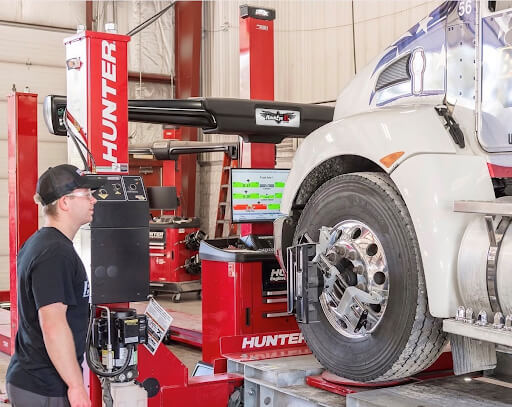
A heavy-duty alignment should go beyond making a quick adjustment to the front axle. Depending on the vehicle and condition being diagnosed, a comprehensive evaluation can include:
- Steer axle toe, camber, and caster
- Drive axle thrust angle and tandem squareness
- Trailer axle positioning relative to the kingpin and other axles
- Inspection of kingpins, bushings, tie rod ends, wheel bearings, torque rods, shocks, and springs
- Tire inflation and wheel balance checks
- Before-and-after alignment measurements
Component inspection is especially important. If worn parts allow the geometry to move again immediately after adjustment, the alignment readings may be correct in the shop but short-lived on the road.
Documented measurements also give fleet managers something valuable: a baseline. When the next tire inspection shows unusual wear, maintenance teams can compare the pattern against actual alignment history rather than guessing.
Turn Scrapped Tires Into Maintenance Data
One of the simplest improvements a fleet can make does not require additional technology. Before worn steer tires leave the yard, inspect them. Record the wear pattern along with the unit number, mileage, tire position, and relevant maintenance history.
If one truck repeatedly feathers steer tires while comparable units do not, that is useful maintenance information. If several trailers develop the same shoulder-wear pattern, the fleet may have uncovered a broader alignment, component, or inspection issue.
Over time, these records can help distinguish an isolated tire problem from a recurring vehicle condition. They can also help maintenance teams identify which units need closer attention and whether corrective work actually solved the problem.
The goal is not simply to get more miles from a tire. It is to use tire wear as an early indicator of conditions that can increase operating costs, affect handling, and create avoidable downtime.
Heavy-Duty Alignment and Tire Wear Analysis from S&S Tire
When irregular tire wear points toward a vehicle problem, correcting the cause can help prevent the next set of tires from developing the same pattern.
S&S Tire provides heavy-duty alignment and tire wear analysis through our commercial service network, including trailer axle alignment. Our team can inspect tire wear, evaluate vehicle alignment and related components, and help determine what is contributing to premature wear.
If your fleet is seeing unexplained steer tire loss, recurring shoulder wear, or trailers that are no longer tracking correctly, contact the S&S Tire commercial team to schedule an inspection.
